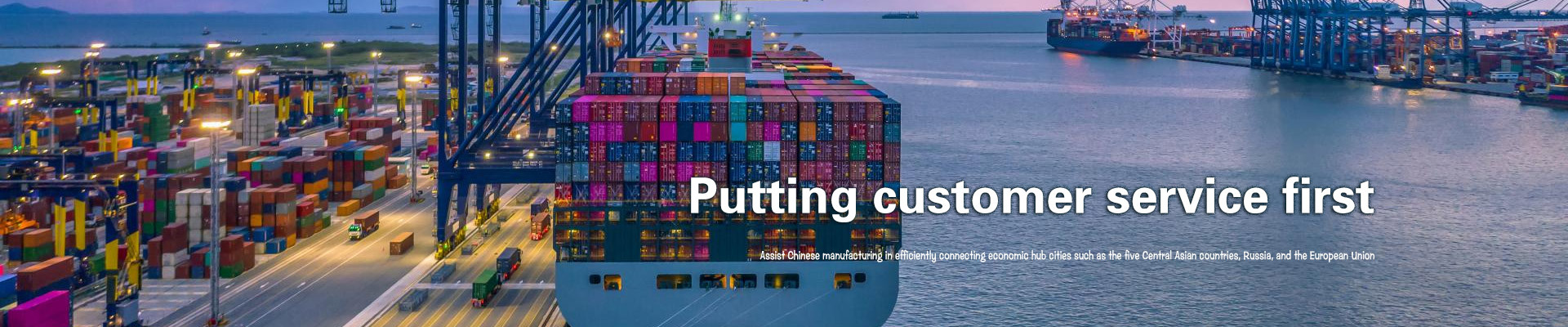
International container transportation is an advanced modern mode of transportation. Compared with traditional bulk shipping methods, it has the characteristics of high transportation efficiency, good economic benefits, and excellent service quality. Therefore, container transportation has developed rapidly worldwide and has become the most optimal mode of transportation for countries to ensure international trade. Especially after decades of development, with the maturity of container transportation software and hardware technology, container transportation entered the era of international multimodal transport by the 1980s. International multimodal transport is a new mode of transportation organization that utilizes containers for intermodal transport. It achieves seamless international transportation of goods through the use of two or more modes of transportation, including sea, land, and air, thus breaking the traditional practice of single transportation modes such as sea, rail, road, and air being disconnected from each other. Nowadays, providing high-quality international multimodal transport services has become an important means for container transport operators to enhance their competitiveness.
1、 Definition and Characteristics of International Multimodal Transport
Multimodal International Transport is a form of transportation organization that aims to optimize the overall transportation efficiency of goods. It usually uses containers as transportation units, organically combining different modes of transportation to form a continuous and comprehensive integrated cargo transportation. Through one consignment, one billing, one document, and one insurance, the entire transportation of goods is jointly completed by the carriers of each transportation section, that is, the entire transportation of goods is arranged as a complete single transportation process. However, it differs significantly from traditional single mode of transportation. According to the United Nations Convention on International Multimodal Transport of Goods (referred to as the "Multimodal Transport Convention") of 1980 and the International Container Multimodal Transport Management Rules jointly issued by the Ministry of Transport and the Ministry of Railways of China in 1997, international multimodal transport refers to the transportation of goods from the place where the multimodal transport operator takes over the goods in one country to a designated place in another country in accordance with the multimodal transport contract, using at least two different modes of transportation. According to this definition, combined with international practices, it can be concluded that international multimodal transport must possess the following characteristics or basic conditions:
(1) Must have a multimodal transport contract. This transportation contract is the contractual relationship and determination of the nature of transportation between the multimodal transport operator and the consignor in terms of rights, obligations, responsibilities, and exemptions. It is also the main basis for distinguishing multimodal transport from general cargo transportation.
(2) A full multimodal transport document must be used. This document should meet the needs of different modes of transportation and charge the full shipping cost according to the single shipping rate.
(3) It must be continuous transportation using at least two different modes of transportation.
(4) It must be international transportation of goods. This is not only different from domestic cargo transportation, but mainly involves the application of international transportation regulations.
(5) A multimodal transport operator must be responsible for the entire transportation of goods. The multimodal transport operator is not only a party to the multimodal transport contract, but also the issuer of the multimodal transport document. Of course, while the multimodal transport operator fulfills the transportation responsibilities stipulated in the multimodal transport contract, they may entrust all or part of the transportation to others (sub carriers) and enter into a sub transport contract. But there is no contractual relationship between the carrier and the shipper in the separate shipment contract.
From this, it can be seen that the main feature of international multimodal transport is that the multimodal transport operator signs a transport contract with the consignor to organize the entire transportation process, implementing a one-time consignment, one order to the end, one charge, unified claims and full responsibility for the entire transportation process. It is an advanced form of cargo transportation organization aimed at facilitating shippers and cargo owners.
2、 The superiority of international multimodal transport
International multimodal transport is a more advanced form of transportation organization than segmented transport. In the 1960s, the United States was the first to pilot multimodal transport services, which were welcomed by shippers. Subsequently, international multimodal transport began to be adopted in North America, Europe, and the Far East; In the 1980s, international multimodal transport was gradually implemented in developing countries. At present, international multimodal transport has become a new and important mode of international container transportation, receiving widespread attention from the international shipping industry. The United Nations Convention on International Multimodal Transport was established at the United Nations Conference on International Multimodal Transport held in Geneva in May 1980. The convention will come into effect one year after being ratified and acceded to by 30 countries. Its implementation will have a positive impact on the future development of international multimodal transport.
International multimodal transport is the future direction of international transportation development, as it has many advantages, mainly manifested in the following aspects:
(1) Simplify the procedures for consignment, settlement, and claims, saving manpower, material resources, and related costs: Under international multimodal transport, regardless of the distance of goods transportation, it is jointly completed by several modes of transportation, and regardless of how many conversions the goods undergo during transportation, all transportation matters are handled by the multimodal transport operator. And the shipper only needs to handle one shipment, sign a transportation contract, pay the fees and insurance once, thus saving the inconvenience of handling the shipping procedures for the shipper. At the same time, due to the use of a single shipping document and unified billing in multimodal transport, the procedures for document preparation and settlement can be simplified, saving manpower and material resources. In addition, if there is any damage or shortage of goods during transportation, the multimodal transport operator is responsible for the entire transportation process, which can also simplify the compensation procedures and reduce claims costs.
(2) Shortening the transportation time of goods, reducing inventory, minimizing cargo damage and accidents, and improving freight quality: Under international multimodal transport, various transportation links and vehicles are closely coordinated, tightly connected, and the goods are quickly and timely transferred wherever they go, greatly reducing the transit time of goods and fundamentally ensuring the safe, rapid, accurate, and timely arrival of goods at their destination, thus correspondingly reducing the inventory level and inventory cost of goods. At the same time, multimodal transport uses containers as transport units for direct transportation. Although multiple conversions are required during the transportation process, the use of specialized machinery for loading and unloading, and the absence of cargo in the tank, greatly reduces cargo damage and accidents, thereby greatly improving the quality of cargo transportation.
(3) Reduce transportation costs and save various expenses: Due to the implementation of door-to-door transportation in multimodal transport, shippers can obtain shipping documents and settle foreign exchange based on them after the goods are handed over to the first carrier, thereby advancing the settlement time. This not only accelerates the turnover of funds occupied by goods, but also reduces interest expenses. In addition, as the goods are transported in containers, in a sense, it can correspondingly save expenses such as packaging, tallying, and insurance for the goods.
(4) Improving transportation management level and achieving rationalization of transportation: For section transportation, due to the self-management of various transportation modes and their own systems, their business scope is limited, and the corresponding freight volume is also limited. Once different operators participate in multimodal transport, the scope of operation can be greatly expanded, and the existing equipment can be maximized to choose the best transportation route and organize rational transportation.
(5) Other functions: From the perspective of the government, the development of international multimodal transport has the following important significance: it is conducive to strengthening the government's supervision and management of the entire goods transportation chain; Ensure that the country obtains a significant proportion of freight revenue throughout the entire transportation process of goods; Helps to introduce new advanced transportation technologies; Reduce foreign exchange expenses; Improve the utilization of domestic infrastructure; Ensure the use of transportation methods with minimal environmental damage through the macroeconomic regulation and guidance functions of the country to achieve the goal of protecting the country's ecological environment.